Most people who use Zerodha for trading or mutual funds also have money sitting in fixed deposits somewhere else. A different bank, a different login, a different maturity date written down in a notes app or a diary. Coin’s new fixed deposit feature does not reinvent the FD. It just brings it into the same place where you already manage everything else.
Here is what the feature actually offers, how it works, and what it does not do.
What Coin’s FD Feature Is
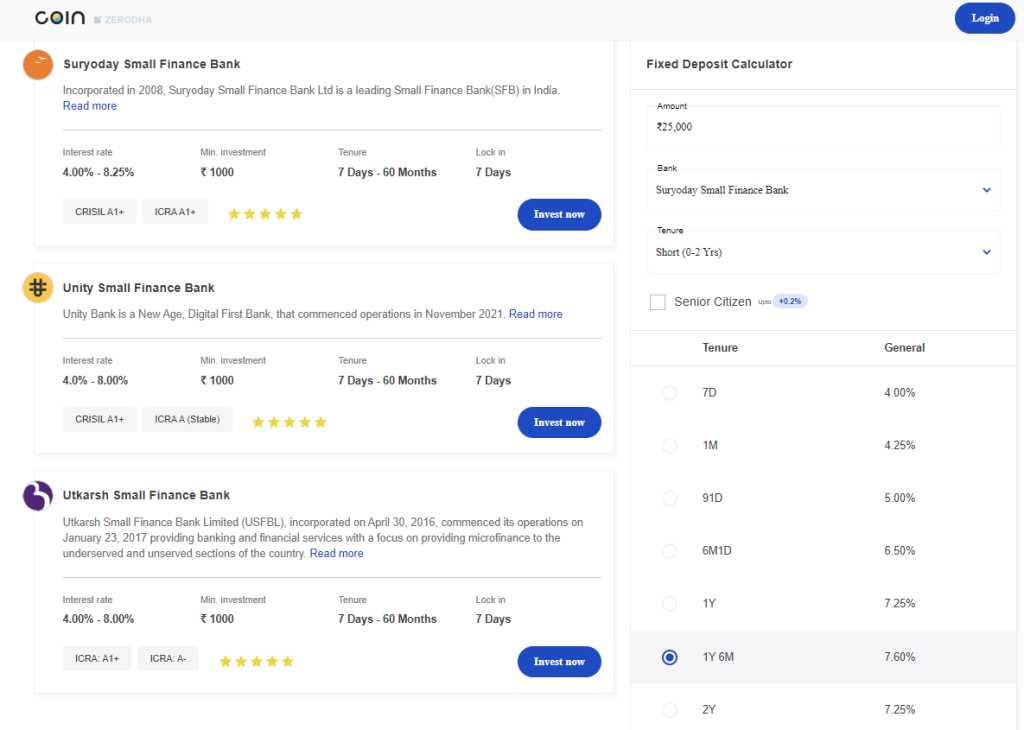
Zerodha launched fixed deposits on Coin on April 9, 2026. The feature lets you book FDs from partner banks directly within the Coin app or on the web, without needing to open a savings account with those banks separately. You compare rates, choose a tenure, enter your amount, complete a one-time KYC, and the deposit is booked. Everything from invested amount to accrued interest to upcoming maturities is then visible in one place inside Coin.
Zerodha acts as a distributor for these FDs. The deposits themselves are with the partner banks, not with Zerodha. This distinction matters and is covered below.
The Banks and Rates
The launch covers three small finance banks: Suryoday Small Finance Bank, Utkarsh Small Finance Bank, and Unity Small Finance Bank. All three are regulated by the Reserve Bank of India. Rates of up to 8.0% per annum are available across the three banks at launch, with senior citizens eligible for higher rates applied automatically based on PAN verification.
Small finance banks are a category created by the RBI to serve underserved segments of the financial system. They are subject to higher capital requirements and regulatory oversight than many other financial institutions. The higher interest rates they offer compared to large commercial banks reflect their need to attract deposits competitively, not a lack of regulatory standing.
Tenures range from 7 days to 60 months. The minimum investment is Rs. 1,000. There is no upper limit stated per FD, though UPI payments are capped at Rs. 1 lakh per transaction, so larger investments go through net banking.
How the KYC and Booking Process Works
For your first FD with any of the partner banks, a one-time KYC is required. This covers PAN verification, Aadhaar authentication, nominee details, and mobile OTP verification. After payment, a short video KYC must be completed within three days. Once that is done, the FD is booked and confirmation is sent.
For any subsequent FDs with the same bank, the KYC step is skipped, making the process significantly faster. For a different partner bank, the one-time KYC applies again.
Coin charges zero fees for opening, maintaining, or managing FDs on the platform. Brokerage charges do not apply since FDs are not traded instruments.
What DICGC Insurance Means in Practice
All three partner banks are covered under DICGC, the Deposit Insurance and Credit Guarantee Corporation, which is a wholly-owned subsidiary of the RBI. Deposits are insured up to Rs. 5 lakh per depositor per bank, covering both principal and interest combined. This is the same insurance framework that applies to deposits in large nationalised banks.
The per-bank structure of the insurance is worth understanding clearly. If you have Rs. 4 lakh in Suryoday and Rs. 4 lakh in Utkarsh, both are separately insured up to Rs. 5 lakh each. If you have Rs. 6 lakh in a single bank, only Rs. 5 lakh of that is covered. The coverage is per depositor per bank, not per FD or per account.
Interest Payout and Maturity Options
When booking an FD on Coin, you choose how interest is paid: at maturity, monthly, or quarterly. You also choose what happens when the FD matures: either the principal is refunded to your bank account, or the FD is automatically renewed. Auto-renewal can be turned off and Coin sends a notification before it executes, giving you time to change the preference.
Premature withdrawal is permitted after 7 days. The applicable penalty based on the bank’s terms is shown upfront before you confirm the withdrawal, so there are no hidden deductions.
Taxes on FD Interest
Interest earned on fixed deposits is taxable as income under your applicable income tax slab. Banks deduct TDS if the total interest earned with that bank in a financial year exceeds Rs. 40,000 for general investors and Rs. 50,000 for senior citizens. Since TDS is calculated per bank separately, if you hold FDs across multiple banks through Coin, you will need to consolidate and report total interest across all of them when filing your income tax return.
Tax certificates and details are available on the platform for reporting purposes. For TDS exemption, Form 15G or Form 15H can currently be filed online for Suryoday Small Finance Bank directly through the platform. For other partner banks, the form needs to be submitted directly to the bank.
What This Feature Does Not Do
Fixed deposits booked through Coin cannot be pledged as collateral for F&O margin. This is a confirmed limitation and is stated directly in Zerodha’s announcement. Traders who were hoping to use FD holdings as margin for derivatives positions cannot do so with this product.
The feature is available only to Indian residents aged 18 and above with an active Zerodha trading and demat account. NRI accounts are not supported at launch.
FDs booked on Coin are not savings accounts with the partner banks. You do not get a savings account, debit card, or any banking services from these banks through the Coin integration. The relationship is limited to the fixed deposit instrument itself.
The Practical Angle for Existing Zerodha Users
If you already use Coin for mutual funds, the FD feature sits inside the same app with no additional login. Your idle cash that currently sits in a savings account earning 2.5% to 3.5% can instead be placed in an FD earning meaningfully more, without moving to a different platform or managing a new set of login credentials.
The tracking feature is where the practical value compounds for people with multiple FDs. Instead of logging into three different banks to check maturity dates and accrued interest, everything is visible from a single Coin dashboard. That alone addresses one of the most common frustrations with managing FDs across institutions.