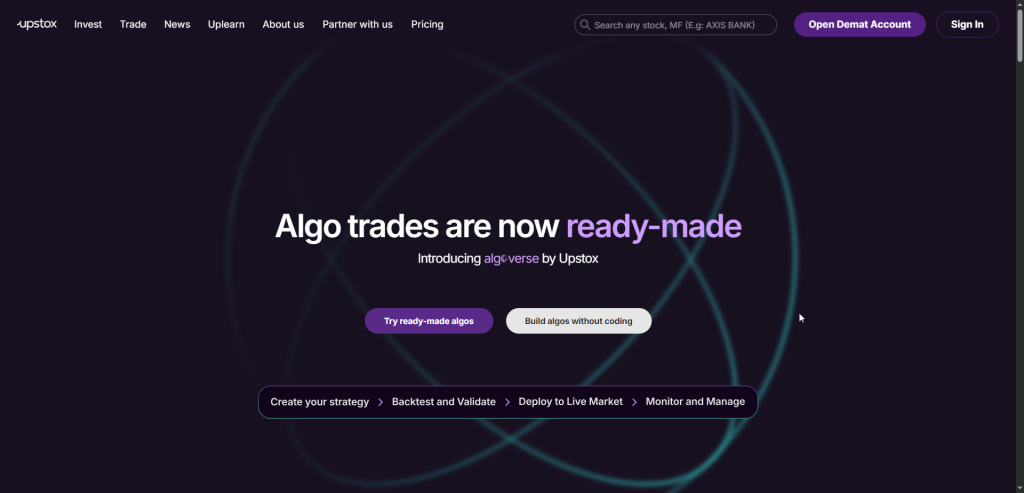


Upstox launched Algoverse on February 11, 2026, and since then a fair number of traders have been searching for a straight explanation of what it actually is. The name sounds technical, and algo trading as a category has always felt out of reach for most retail traders. This article explains what Algoverse is, what it can do, what it costs, and what it currently does not cover.
What Algoverse Is
Algoverse is Upstox’s algorithmic trading platform built specifically for retail traders. It is built on SEBI’s retail algo framework, which means it operates within the regulatory structure that governs automated trading for individual investors in India.
The core purpose is to let traders automate their trading strategies without writing code. You define the rules for when to enter and exit a trade, the platform executes those rules automatically during market hours. You are not clicking buy and sell manually; the system does it based on the conditions you have set.
Algoverse is available on web and Android. iOS support was not available at launch.
Two Ways to Use It
There are two distinct modes inside Algoverse.
The first is ready-made strategies. These are pre-built algos created by SEBI-registered Research Analysts. Each strategy comes with backtested historical performance data showing past returns, maximum drawdown, and risk metrics. You browse the available strategies, filter by capital requirement and instrument type, review the backtested results, and deploy the one that fits your approach. You are not building anything; you are selecting from a curated list and activating it.
The second is building your own strategy. This is a no-code strategy builder where you define your own entry and exit conditions using technical indicators. You pick your instrument, select indicators, set the rules for when each condition triggers a trade, and the platform handles execution. You do not write code at any point.
Both paths go through the same four-step flow: create, backtest on historical data, deploy to live markets, and monitor.
What Instruments It Covers
Algoverse currently covers index and stock F&O contracts. The ready-made strategy library is organised into categories: equity options algos, option buying algos, hedged option algos, stock option algos, option selling algos, and index futures algos. Instruments referenced in the available strategies include NIFTY, BANKNIFTY, and SENSEX futures and options contracts.
Cash segment stocks and commodities options are not covered at present. This was confirmed directly by Upstox in their community forum in response to user questions after launch.
Indicators and Tools Available
When building your own strategy, Algoverse provides access to over 80 technical indicators. These include standard tools like RSI, MACD, Supertrend, Bollinger Bands, CCI, and Pivot Points, among others. You can combine multiple indicators to set up layered entry and exit conditions.
For multi-leg options strategies, the platform supports designing and testing spreads and structured positions, monitoring combined premiums, and defining execution rules for each leg.
Algoverse also integrates with TradingView, allowing you to execute algos automatically from TradingView charts and receive alerts when actions are triggered.
Paper trading is available, meaning you can run strategies in a simulated environment before committing real capital.
Backtesting
Both ready-made strategies and custom-built strategies can be backtested on historical data. Upstox has referenced 8 years of historical data as the available backtest range. Backtest results show past returns, maximum drawdown, and risk metrics. These results are historical and do not guarantee future performance.
For ready-made strategies, the risk parameter displayed is called Risk Per Trade (RPT). This is calculated using the Kelly Criterion framework and represents the portion of capital that can be risked per trade based on the strategy’s historical performance. It ranges from 0% to 5%. A higher RPT suggests more capital can be efficiently risked based on the historical record. The RPT figure is not a stop-loss parameter and should not be used directly as a risk management number. When assessing downside risk, the historical maximum loss from the backtest period is the more relevant figure.
Pricing
Algoverse charges Rs. 10 per algo per day, plus GST. This charge applies for every day the strategy is active and monitoring market conditions, regardless of whether any trade is executed. If you deploy a strategy for 5 days but no trades trigger, you are still charged Rs. 10 per day for those 5 days. Brokerage charges on actual trades are separate and follow Upstox’s standard brokerage structure.
How Funds and Capital Work
Your capital stays in your Upstox trading account at all times. Algoverse does not hold your funds. It only executes trades on your behalf using the margin and capital available in your account. You retain full control of your money throughout.
When filtering ready-made strategies, you can set a capital range to display only strategies that match your available capital. The minimum capital requirement varies by strategy.
What Algoverse Is Not
A few points worth being clear about given the confusion around algo trading platforms generally.
Algoverse is not an investment advisory service. The ready-made strategies are built by SEBI-registered RAs and come with historical performance data, but deploying a strategy does not mean you are receiving personalised investment advice. The strategies execute rules automatically; they do not make judgement calls on market conditions in real time.
It is not a black-box system that trades without your input. You choose which strategy to deploy or build your own rules. The automation handles execution of those rules, but the decision to deploy, pause, or stop a strategy remains with you.
It does not guarantee returns. Backtested historical results are presented transparently with drawdown data, but past performance of a strategy does not guarantee the same results going forward.
It is not available for cash equities or commodities options at present.
The Context
According to NSE data cited by Upstox at launch, roughly 70% of F&O trades on Indian exchanges are now executed by algorithms. Algoverse is Upstox’s response to the gap between that reality and the tools available to retail traders, most of whom have been executing manually in a market where a large portion of the other side of their trades is automated.
Whether Algoverse fills that gap usefully will depend on how individual traders find the backtest quality, execution reliability, and strategy selection over time. The community forum on Upstox has active discussion on early experiences, and the product team has been responding to feature requests and reported issues directly in the thread since launch.