Imagine you are trying to book a cab on a rainy evening during peak hours. Every cab is taken, surge pricing is on, and the app keeps showing “no cabs available nearby.” You need the cab more than the cab needs you. You will pay whatever it takes. The driver, or rather the platform, is completely in control.
Now imagine a quiet Tuesday afternoon. Dozens of cabs are circling your area with no passengers. Drivers are competing for your booking. If one cancels, three more appear. You are in no rush. You have options.
That single shift in who needs whom more is exactly what separates a seller’s market from a buyer’s market in the stock market.
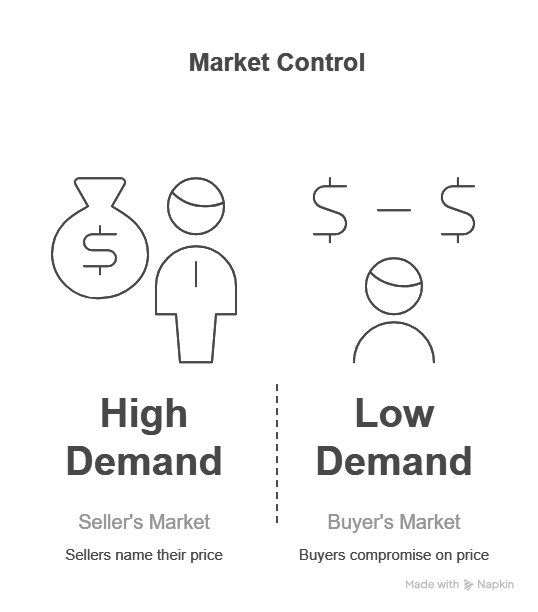


When Sellers Are in Control
A seller’s market happens when more people want to buy a stock than there are people willing to sell it. Sellers know they are in demand. They have no reason to lower their price. If one buyer walks away, five more are standing behind him.
Think back to the post-Covid rally between 2020 and 2021. Retail investors flooded into the markets. Everyone wanted to own stocks. Companies that had barely any business were seeing their share prices double and triple. Sellers were laughing. They could name their price. Buyers were paying up just to get in, afraid of missing out entirely.
In a seller’s market, the person holding the asset has all the patience in the world. The person wanting to buy is the one sweating.
When Buyers Are in Control
A buyer’s market flips that power completely. Now there are more people trying to sell than there are willing buyers. Sellers become desperate. They start lowering their expectations just to find someone interested.
Think of what happened during the 2008 financial crisis or even the sharp correction in early 2020 when Covid first hit. Panic was everywhere. People were rushing to sell their stocks at almost any price because they were terrified of further losses. Buyers who stayed calm and had cash could pick up quality companies at prices that seemed unimaginable just months before. Warren Buffett’s famous line applies perfectly here: “Be greedy when others are fearful.”
In a buyer’s market, the person with cash is king. The seller is the one compromising.
The Same Stock Can Switch Between the Two
Here is what most people miss. A seller’s market and a buyer’s market are not fixed conditions for the entire market at all times. A single stock can shift from one to the other based on news, sentiment, or sector momentum.
Imagine a pharmaceutical company that just got approval for a major drug. Overnight, everyone wants the stock. Holders are in no rush to sell. That stock has entered a seller’s market, regardless of what the broader index is doing.
Now imagine the same company two years later, facing a patent expiry and a revenue decline. Institutions are quietly exiting. Retail investors are nervous. Buyers are scarce. The stock has entered a buyer’s market.
The company did not change in a vacuum. The balance of who needs whom more changed.
Why Understanding This Changes How You Think About Investing
Most investors focus entirely on whether a stock will go up or down. That is important, but understanding market character tells you something equally valuable: whether you have time on your side or not.
In a seller’s market, waiting for a better price often means never getting the stock at all. The price simply does not come back to where you wanted it. The market rewards those who act.
In a buyer’s market, impatience is expensive. If you rush to buy a falling stock because it looks cheap, it may get cheaper still. The market rewards those who wait.
This is not about predicting the future. It is about reading the present. Is this a market where sellers are comfortable holding out, or one where buyers are in a position to dictate terms? That single question can change whether you chase a stock or let it come to you.
A Simple Way to Remember the Difference
Go back to the cab analogy one last time.
Rainy evening, peak hours, no cabs available. You are the buyer, and you have no leverage. That is a seller’s market.
Quiet afternoon, cabs everywhere, no passengers. The driver needs your fare more than you need his cab. That is a buyer’s market.