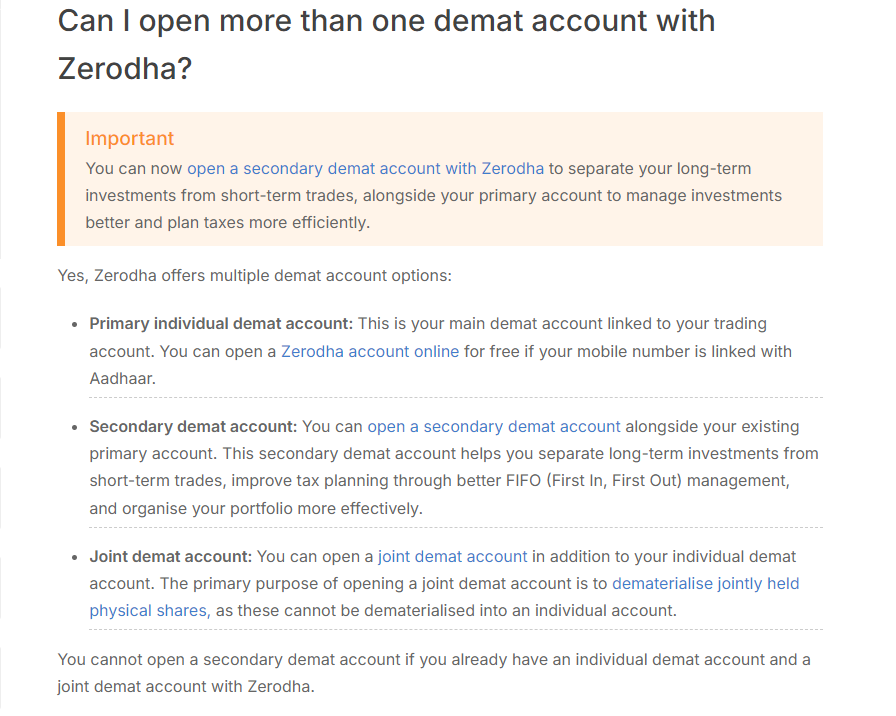


Zerodha just dropped a quiet update that many active traders and long-term investors using their platform have been waiting for: the ability to open a secondary demat account. For years, one demat account meant everything, from quick intraday swings to those multi-year portfolio bets, was all lumped together. Now, that’s changing.
Essentially, Zerodha is letting you set up an additional demat account alongside your existing individual one. Think of it as having two separate buckets for your holdings, both still under your name. The big idea here is segmentation – specifically, separating your long-term investments from your short-term or trading positions.
Why does this matter?
For anyone who tries to keep a clean sheet for tax purposes or just wants better portfolio clarity, this is a practical win. Right now, when you sell shares, the First-In, First-Out (FIFO) rule applies across the board. If you bought 100 shares of Reliance in January for a long-term hold and then another 100 in March for a quick swing trade, selling 100 shares in April would first liquidate the January lot, regardless of your intention. This often messes with tax calculations, turning what you intended as a short-term capital gain/loss into a long-term one, or vice-versa, or just making accounting a headache. With a secondary demat, you can ring-fence your long-term portfolio, ensuring trades in your “trading” demat don’t accidentally liquidate your “investing” holdings and vice-versa.
So, who’s this actually useful for?
Primarily, it’s a boon for active traders who also maintain a substantial long-term investment portfolio. If you’re constantly buying and selling, but also accumulating shares for retirement or specific long-term goals, this feature can simplify your life significantly. It helps you avoid the FIFO rule complexities that often lead to a scramble during tax filing. It also makes it easier to visually track performance for different strategies without having to manually filter trades and holdings constantly. Investors who purely buy and hold, making only a handful of transactions a year, probably won’t find this revolutionary. Similarly, if your trading capital is quite small and you’re not juggling multiple strategies, the single demat might still be perfectly adequate.
It’s worth noting that this isn’t a completely novel concept in the broking world; some legacy brokers have had similar offerings for a while, though perhaps not always as straightforward to set up. But for a tech-first broker like Zerodha, known for its clean interface and focus on serious traders, this is a significant step towards addressing a genuine pain point for their power users.
This new option also highlights a common practice among seasoned traders and investors: often, they use multiple platforms or accounts to segment their strategies, or even just to compare tools. While this Zerodha update helps consolidate some of that within a single broker, many still find value in having a primary trading account with one broker (like Zerodha or Fyers) and perhaps a dedicated long-term investing account with another (maybe Groww or a bank-linked demat) for even greater separation. For those who track their portfolios across various brokers, tools like TradingView and other third-party portfolio trackers remain essential for a consolidated view.
In short, if your investing and trading styles are distinct, and you’ve been wrestling with FIFO-related tax hassles or just wish for clearer portfolio segregation, Zerodha’s secondary demat account is definitely worth looking into. It’s a practical enhancement that targets a real-world problem for many active market participants.
Keep in mind, you generally can’t open a secondary demat if you already have both an individual demat and a joint demat account with Zerodha. The secondary account is meant for an individual’s primary trading/investing split, not for additional joint holdings.